Capsule Wardrobe
Uniform dressing: why some people wear the same thing every day
It is usually explained as decision fatigue, which is a shakier concept than it sounds. The better arguments for a personal uniform are simpler and hold up better.
The personal uniform — wearing the same outfit, or a small set of near-identical outfits, every day — has a long list of famous adherents and a standard justification: eliminating clothing decisions conserves mental energy for important ones.
That justification is worth examining, because the research behind it is weaker than its popularity suggests.
The decision fatigue problem
Decision fatigue — the idea that willpower and decision quality deplete like a resource across a day — comes largely from Roy Baumeister's ego depletion research.
The concept has had a difficult decade. Large multi-lab replication attempts have failed to reproduce the core effect, and the field now treats it as, at best, considerably smaller and more context-dependent than originally claimed.
The frequently cited study of Israeli parole judges granting fewer paroles as sessions wore on has also been challenged on the grounds that case ordering was not random.
So the strongest version of the claim — that choosing a shirt measurably degrades your afternoon judgement — is not well supported.
Time. Not mental energy — actual minutes. Ten minutes a day is roughly sixty hours a year.
Reliability. If you know an outfit works, you never leave the house uncertain.
Shopping efficiency. Knowing exactly what you buy eliminates browsing, impulse purchases and mistakes.
Recognisability. A consistent visual identity is genuinely useful for some people professionally.
How it actually works in practice
Almost nobody wears one literal outfit. What people describe as a uniform is usually a formula — a fixed structure with limited interchangeable components.
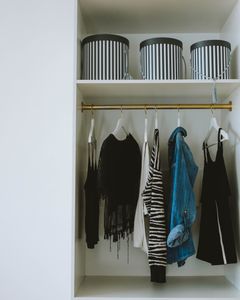
For example: dark trousers, a plain top in one of four colours, a jacket or knit, the same shoes. The structure is fixed; three or four elements vary.
This produces the reliability benefit while avoiding the two failure modes of a literal uniform — laundry logistics, and the fact that a single outfit cannot cover all temperatures and occasions.
Building one
Start from your worn pile. If you have done a wardrobe audit, the answer is already visible — the things you reach for repeatedly are your uniform, and you have been wearing one without noticing.
Identify the structure. What is the shape? Fitted top and wide trouser? Layered with a jacket? Dress and boots? Write it down as a formula rather than as garments.
Fix the constants. Usually the trousers, the shoes and the outer layer. These are the expensive items and the ones that set the silhouette.
Allow limited variables. Colour of the top. Which knit. An accessory. Enough to accommodate weather and mood without reintroducing the decision.
Buy multiples of what works. This is the step people resist and it is the most useful. If a particular t-shirt or shirt is right, buying three or four means you always have a clean one and you stop looking for alternatives.
The seasonal problem
A uniform has to survive a temperature range, and the answer is layering rather than separate wardrobes.
Keep the base consistent and vary the layers over it: the same trousers and top with a shirt over in autumn, a knit in winter, alone in summer. The silhouette stays recognisable and the warmth adjusts.
Where it fails
Occasions outside the formula. A uniform built for work does not cover a wedding, a beach or a job interview in a different industry. Most uniform-wearers keep a small number of outliers, which is sensible and slightly undermines the purity of the concept.
Boredom. For some people clothing is a pleasure and a form of expression, and a uniform removes it. This is a legitimate reason not to do it, and the productivity framing tends to treat enjoyment as an inefficiency, which is a poor way to think about a life.
Wear rate. Wearing the same garments daily wears them out faster and concentrates abrasion. Rotation matters more, not less.
Perception. The famous adherents cited in every article about this were mostly men in positions where their competence was not in question. The social latitude to wear the same thing daily is not evenly distributed, and it is worth being honest that the strategy is easier for some people than others.
The middle position
Most people who benefit from this idea do not adopt a uniform. They adopt a small number of known-good outfits — five or six complete combinations that they know work — and rotate them.
That captures the reliability and most of the time saving, without the rigidity or the wear concentration. And it requires nothing more than noticing which combinations you already reach for, and writing them down.
Also by Noor Haddad
- Building a capsule wardrobe by subtraction rather than purchaseCapsule Wardrobe
- Cost per wear: the only shopping arithmetic worth doingShopping Smart
- Why some colours suit you: contrast and undertone, without the seasonsColour & Pattern
- Buying clothes secondhand online without being disappointedShopping Smart