Capsule Wardrobe
Building a capsule wardrobe by subtraction rather than purchase
Every capsule guide starts with a shopping list. The useful version starts with the clothes you already own and the discovery that you wear about a fifth of them.

The capsule wardrobe idea is usually attributed to Susie Faux, who ran a London boutique called Wardrobe in the 1970s, and it was popularised by Donna Karan's Seven Easy Pieces collection in 1985.
The original idea was sound: a small number of well-chosen, coordinating garments that combine into many outfits. What it has become is a shopping list — buy these thirty items, in these colours, from these brands — which inverts the point entirely.
The version that works starts with what you own.
Step one: find out what you actually wear
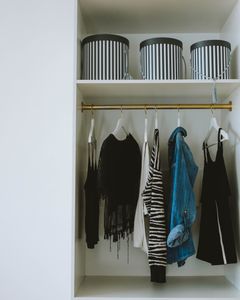
Most people have a strong opinion about their wardrobe and no data. The hanger method fixes that.
Turn every hanger in your wardrobe backwards. When you wear something and put it back, hang it the normal way round. Do the same with drawers using a simple list, or by moving worn items to one side.
After three months, look at what is still backwards.
The typical result is uncomfortable. Most people find they wear a small fraction of what they own — the frequently quoted figure is around 20 per cent, and while the original source for that is difficult to trace, everyone who runs the experiment finds a version of it.
Does it fit? Not "will it if I lose weight" — does it fit the body you have.
Is it comfortable? Anything that itches, gapes, rides up or requires adjustment will not get worn, however good it looks.
Does it go with at least three other things you own? Orphan garments stay unworn.
Is it appropriate for a life you actually lead? Most wardrobes contain clothes for an imagined life — the formal events you do not attend, the office you no longer work in.
Step two: identify what your life actually requires
Divide a week into the contexts you genuinely occupy, and estimate the proportion. Work. Home. Exercise. Social. Formal.
Then compare that against your wardrobe. The mismatch is usually stark: people who work from home four days a week frequently own a wardrobe weighted toward an office they visit once a fortnight, and own almost nothing they feel presentable in at home.
This exercise, more than any list of essential items, tells you what to buy.
Step three: find the gaps, not the missing essentials
The standard capsule lists include a trench coat, a white shirt, a blazer, a little black dress. These are somebody else's essentials.
Your gaps are the specific occasions where you have nothing to wear — the situations where you consistently improvise, feel wrong, or fall back on something you dislike.
Write those down. That list is short, specific, and considerably more useful than any generic one.
Step four: build a coherent colour base
This is where the capsule idea earns its reputation. Interchangeability comes from colour discipline more than from anything else.
Pick two or three neutrals that work together and suit you — navy, grey, black, charcoal, cream, camel, olive, brown. Note that black and navy together is difficult, and that black and brown together requires deliberate handling.
Then allow a small number of accent colours that all work with those neutrals.
The test of a capsule is not how many items it contains but how many of them go with each other. Twelve pieces where everything works with everything is more useful than thirty where half the combinations fail.
Step five: buy slowly and deliberately
Having a list does not mean buying everything on it this month.
Two rules that work. Wait a week on anything not on the list — most wants evaporate. And one in, one out, which forces a comparison: is this genuinely better than what it replaces?
What the capsule idea gets wrong
Three honest criticisms.
The numbers are arbitrary. Thirty-three items, thirty-seven, whatever — these are marketing devices. Someone who cycles to work in British weather needs more clothes than someone who drives in Los Angeles.
It can encourage buying. The commonest failure mode is reading a capsule guide and immediately purchasing twenty new items to build one, which is the opposite of the intent.
It can be joyless. A wardrobe of grey neutrals is efficient and, for a lot of people, miserable. The point is not minimalism as an aesthetic. It is that fewer, better-chosen clothes that all work together produce more good outfits and less decision fatigue.
If a garment brings you pleasure and you wear it, it belongs in the wardrobe regardless of whether it fits the scheme. The clothes to remove are the ones you neither wear nor enjoy owning — and there are usually a lot of them.
Also by Noor Haddad
- Cost per wear: the only shopping arithmetic worth doingShopping Smart
- Why some colours suit you: contrast and undertone, without the seasonsColour & Pattern
- Buying clothes secondhand online without being disappointedShopping Smart
- Pattern, scale and the reason your check shirt does not workColour & Pattern