Capsule Wardrobe
Layering: why three thin layers beat one thick one
The principle comes from mountaineering and it works in a city. Base, mid, shell — each doing one job, adjustable as conditions change, and considerably more versatile than a single heavy coat.

The layering system was formalised for outdoor use and the physics applies equally to a commute. Warmth comes from trapped still air, not from fabric thickness, and multiple layers trap more air than one thick garment of the same total weight.
More usefully, layers can be removed. A single heavy coat is one temperature setting; three layers are several.
The three jobs
Base layer: manages moisture. Sits against the skin and moves perspiration away from it. This matters more than people expect — damp fabric against skin conducts heat away rapidly, which is why you get cold after stopping.
Merino wool is the best all-round choice: it moves moisture, insulates when damp, and resists odour. Synthetics wick faster and dry quicker and hold smell badly. Cotton is the worst option for this job — it absorbs and holds moisture, then chills you.
Mid layer: provides insulation by trapping air. Fleece, wool knitwear, down, or synthetic insulation. This is where most of the warmth comes from and where the adjustment happens.
Outer layer or shell: blocks wind and water. Wind stripping away the warm air trapped in your layers is what makes cold weather feel much colder than the thermometer suggests, and a thin windproof layer produces a disproportionate improvement.
Cotton absorbs up to 25 per cent of its weight in water and holds it against the skin. Water conducts heat away from the body roughly 25 times faster than air. A damp cotton t-shirt under a coat is actively refrigerating you, which is why you feel colder after exertion than before it.
Making it look intentional
The functional system produces a lot of bulk if applied without thought. Three principles keep it wearable.
Progressive length. Each layer roughly the same length as, or longer than, the one beneath. A shirt hem hanging below a jumper hem is a deliberate look and rarely an accidental success; a jacket shorter than the jumper under it almost never works.
Progressive weight. Thinnest closest to the body, heaviest outside. Otherwise the outer layers strain and the inner ones bunch.
Texture variation. Layers of identical texture read as one confused mass. A smooth shirt, a textured knit and a structured coat read as three distinct things.
The versatile mid layers
The mid layer is where a wardrobe gains the most range for the least money.
A fine merino crewneck or v-neck. Works under a jacket without bulk, over a shirt, or alone. Probably the single most useful garment for layering.
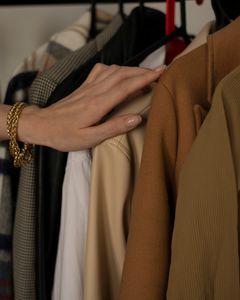
An overshirt or shirt-jacket. Heavier than a shirt, lighter than a jacket, works as either. Fills the enormous gap between cold and mild.
A cardigan. Adjustable in a way a pullover is not, and easy to remove indoors.
A gilet or waistcoat. Adds core warmth without restricting arms, and adds nothing under a coat sleeve — which is the practical constraint on layering under outerwear.
A quilted liner jacket. Wears alone in autumn, goes under a coat in winter.
The sleeve problem
The practical limit on layering. Coat sleeves are cut for one or two layers underneath. A third bunches at the elbow, restricts movement and looks lumpy.
Two solutions. Use a gilet as the additional layer, adding core warmth with no sleeve bulk. Or buy the outer layer with layering in mind — a coat sized for a jumper underneath, which is a reason to try coats on wearing what you will actually wear beneath them.
Adjusting through a day
The point of the system is that it responds to conditions, and using it means actually adjusting.
Before exertion, remove a layer. Starting slightly cool is correct — you warm up within minutes, and sweating into your layers is what makes you cold later.
Regulate through openings before removing anything: unzip, unbutton a collar, push up sleeves, remove a hat. The head and neck lose a disproportionate amount of heat, so a hat is one of the most effective single adjustments available.
Add layers when stopping, before you feel cold.
What to buy first
If a wardrobe is short on cold-weather options, the order that produces the most range is: a good merino base layer, a fine knit mid layer, and a windproof shell. Those three combine with what you already own and cover a considerable range of conditions.
A single very warm coat covers one condition, is too much indoors, and is useless in autumn — which is why so many people own one and still have nothing to wear in October.
Also by Noor Haddad
- Building a capsule wardrobe by subtraction rather than purchaseCapsule Wardrobe
- Cost per wear: the only shopping arithmetic worth doingShopping Smart
- Why some colours suit you: contrast and undertone, without the seasonsColour & Pattern
- Buying clothes secondhand online without being disappointedShopping Smart