Shoes & Accessories
Accessories: the small number that carry the most weight
Belts, bags, watches and scarves are where a competent outfit becomes a considered one — and where cheap materials are hardest to hide, because they sit at eye level and get handled.
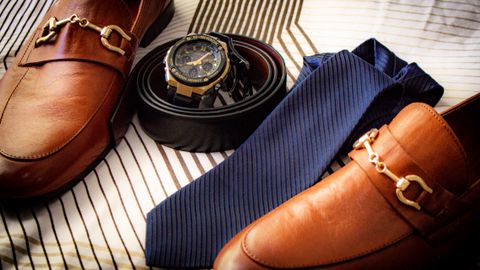
Accessories occupy a strange position. They are optional, which means anything you add is visibly a choice, and they are handled and looked at closely, which means quality is more exposed than in clothing.
Belts
The most common accessory and the one most often bought badly.
Look for full-grain or top-grain leather. Full-grain retains the outer surface of the hide and is the most durable. Top-grain has been sanded to remove imperfections. Below these, "genuine leather" is a marketing term for the lower splits of a hide and is significantly weaker; bonded leather is scraps and adhesive and will delaminate.
Check the edges. A good belt has burnished or painted edges finished smooth. A cheap one has raw cut edges, or a plastic coating that will crack and peel.
Check the construction. A single piece of leather is better than two thin pieces glued together — a glued belt will separate. Stitching along the length indicates layers, which is fine if they are stitched rather than bonded.
Size correctly. Belt size is measured from the buckle fold to the middle hole, not the end. It should be roughly two inches larger than your trouser waist size, and the tail should reach the first belt loop past the buckle.
Match the leather to the shoes in tone rather than exactly. Formality should match too: a dress belt is narrow, around 3 cm, with a small buckle; a casual belt is wider with a heavier buckle.
Full-grain — entire hide surface, strongest, develops patina.
Top-grain — sanded surface, more uniform, slightly less durable.
Genuine leather — lower splits, weak, a misleading name.
Bonded leather — ground scraps in adhesive. Will fail.
Bags
The item where cost per wear reasoning works best, because a good bag is used daily for years.
Check the hardware. Zips are the commonest failure point. Look for branded zips — YKK Excella, Riri, Lampo — and run them a few times. Solid metal fittings, not plated plastic. A magnetic clasp or buckle that feels substantial.
Check the stress points. Where the strap joins the body is where bags fail. Look for rivets, bar tacks, or reinforcement rather than a single line of stitching.
Check the lining. A poor lining tears and cannot easily be replaced, effectively ending the bag.
Check the base. Feet or a reinforced base protect the bottom, which is what wears first.
Weigh it empty. A heavy bag empty is a very heavy bag full, and this is the single most common regret.
Watches
Practical rather than horological considerations.
Case diameter should suit your wrist. Measure your wrist circumference: under 16 cm suits 34–38 mm; 16–18 cm suits 38–42 mm; over 18 cm can carry 42 mm and up. The lugs should not overhang the edge of the wrist.
Thickness matters more than people expect — a thick watch will not fit under a shirt cuff, which is the practical constraint for anything worn with a jacket.
Straps are the cheapest way to change a watch. A leather strap dresses it up, a NATO or rubber strap dresses it down. Spring bar tools cost very little.
Quartz is more accurate and cheaper than mechanical. Mechanical movements are bought for craft and interest, not performance, and that is a legitimate reason.
Scarves
The most efficient accessory in a wardrobe: cheap relative to their impact, they sit next to the face where colour matters most, and they add warmth.
Wool or cashmere for warmth, silk for decoration, linen or cotton for summer.
Length matters for what you can do with it. Around 180 cm allows most wrapping styles; shorter is limited to a simple drape or a single loop.
A scarf in a colour that suits you is a good way to wear a colour that does not suit you elsewhere in the outfit — it puts the flattering tone next to the skin and lets the rest do what it likes.
Eyewear
Worn on the face, so scale and shape matter more than in any other accessory.
Frame width should roughly match the widest part of your face. The frame should not extend beyond the temples.
Contrast the frame shape with the face shape loosely — angular frames on rounder faces, softer frames on more angular ones. This is a tendency, not a rule, and personal preference reasonably overrides it.
Acetate versus metal. Acetate is warmer in colour, bolder, and can be adjusted by heating. Metal is lighter and more discreet.
The general principle
Accessories are handled, held and looked at closely, which is why leather quality, hardware and edge finishing are exposed in a way that fabric quality is not.
Which makes the sensible strategy fewer and better. Two good belts outperform six poor ones, and the difference is visible from a metre away.
Also by Noor Haddad
- Building a capsule wardrobe by subtraction rather than purchaseCapsule Wardrobe
- Cost per wear: the only shopping arithmetic worth doingShopping Smart
- Why some colours suit you: contrast and undertone, without the seasonsColour & Pattern
- Buying clothes secondhand online without being disappointedShopping Smart