Shoes & Accessories
Shoe care that actually extends the life of a pair
Leather is a skin. It dries out, cracks and fails, and the routine that prevents that takes about ten minutes a month.
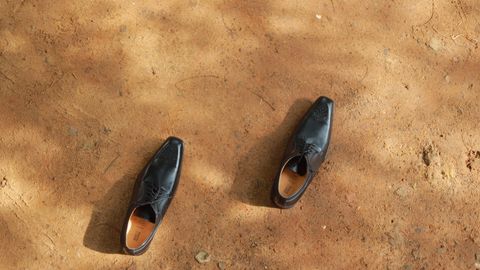
The single biggest factor in how long shoes last has nothing to do with polish. It is rotation.
A foot produces a substantial quantity of moisture over a day — commonly cited figures put it around a quarter of a pint — and most of it is absorbed by the shoe. Leather that stays damp stretches, distorts, and degrades. It needs at least 24 hours to dry properly.
Alternating two pairs will more than double the life of both. Three pairs is better still. This is a bigger effect than any product.
Shoe trees
The second most important item, and the one most people skip.
Cedar shoe trees do three things: they hold the shoe in shape as it dries, preventing the toe from curling upward; they smooth out the creases across the vamp so they do not deepen into cracks; and cedar absorbs moisture and odour.
Insert them while the shoe is still warm, immediately after taking them off. That is when the leather is most pliable and the tree can do the most.
Buy the right size — a tree that is too small does nothing and one that is too large stretches the shoe. Full-heeled, split-toe trees are considerably more effective than the cheap plastic or single-piece variety.
Every wear: shoe trees in, straight away.
Every few wears: brush off dirt with a horsehair brush.
Every 10–15 wears: clean, condition with cream, polish with wax.
When the sole wears thin: resole, before the welt is damaged.
The full clean
1. Remove laces and trees. Laces catch polish and the tongue needs access.
2. Brush thoroughly with a horsehair brush to remove surface dirt and grit. Grit left in the welt seam abrades the stitching.
3. Clean. A damp cloth for light dirt; a dedicated leather cleaner or saddle soap for build-up. Old polish accumulates over time and needs removing occasionally with a leather cleaner, or the leather stops breathing.
4. Condition. Apply a cream conditioner or shoe cream with a cloth or dauber brush, working it into the leather. This is the step that actually matters for longevity — it replaces the oils that keep leather flexible. Cream also carries pigment, which restores colour and covers scuffs.
Let it absorb for 15–20 minutes.
5. Brush off with a clean horsehair brush, vigorously. This removes excess and generates a little heat, which helps.
6. Wax, if you want shine. Wax polish sits on the surface, adds protection and produces gloss. It does not condition — that was step 4. Apply thinly, let it haze, buff off.
7. Replace trees.
Cream versus wax
The distinction most people miss.
Cream penetrates. It nourishes, restores colour and keeps leather supple. This is the health step.
Wax sits on top. It protects against water and abrasion and produces shine. This is the cosmetic and protective step.
Using only wax over years produces leather that looks fine and is quietly drying out underneath. Using only cream produces healthy leather with no protection.
Water
Wet shoes need care and the instinct is wrong.
Never dry leather near a radiator or with heat. Rapid drying drives out oils and makes leather brittle and cracked, permanently.
Stuff with newspaper, changing it as it absorbs, and dry slowly at room temperature away from direct heat. Insert trees once mostly dry. Condition afterwards, because the water will have taken oils with it.
Salt stains from winter pavements should be removed promptly with a solution of one part white vinegar to two parts water — salt draws moisture out of leather and causes cracking.
Suede and nubuck
Entirely different, and cream and wax will ruin them.
Use a suede brush — brass or rubber — to lift the nap and remove dirt, always brushing in one direction. A suede eraser for marks. A dedicated suede protector spray, reapplied periodically.
Water spots on suede can often be fixed by dampening the whole panel evenly and brushing once dry. Do not attempt to spot-clean a water mark; even it out instead.
Soles
Check them periodically. When the sole is worn thin — hold it to the light and look for translucency, or press for flex — get it resoled.
Doing this early is the difference between a routine resole and a major repair. Once the sole wears through and the welt stitching is exposed and damaged, the cost rises steeply and the shoe may not be salvageable.
A thin rubber half-sole, or topy, fitted to a new leather sole costs little, is nearly invisible, and roughly doubles the interval between resoles. For anyone walking on pavements rather than carpet, it is the best value in shoe care.
Also by Gil Mowatt
- The four alterations that change everything, and what they should costFit & Tailoring
- How a jacket should fit, starting with the only part you cannot changeFit & Tailoring
- How shoes are built, and why it determines whether they can be repairedShoes & Accessories
- Trouser length: the detail everyone notices and nobody mentionsFit & Tailoring