Shoes & Accessories
Loafers, derbies, oxfords: which shoe goes with what
The formality ranking of men's shoes is one of the few genuinely consistent conventions in dress, and it is determined by lacing, toe shape, decoration and colour, in that order.
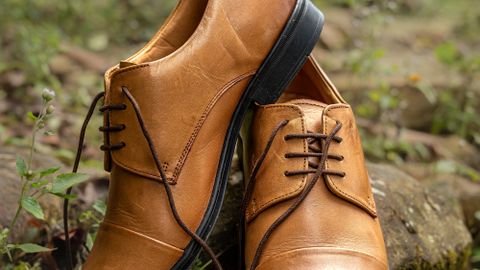
Shoe formality is governed by four variables. Once you can read them, any unfamiliar shoe can be placed on the scale without knowing its name.
Variable one: the lacing
The most important, and the distinction most people miss.
Oxford (called a balmoral in America) has closed lacing: the facings carrying the eyelets are stitched underneath the vamp, so when laced they meet in a clean V with no gap. This produces a sleek, closed silhouette and is the more formal construction.
Derby (a blucher in America, though strictly a blucher is a variant) has open lacing: the facings are stitched on top of the vamp and remain separate, opening outward. Less formal, and more accommodating of a high instep — which is a genuine practical reason to prefer them regardless of formality.
Look at where the lace panels meet the front of the shoe. If they disappear underneath, it is an oxford. If they sit on top, it is a derby.
Variable two: the toe and the decoration
Less decoration is more formal.
Plain toe — no seam across the toe. The most formal.
Cap toe — a horizontal seam across the toe. Slightly less formal, and the most versatile business shoe there is.
Wingtip or brogue — a wing-shaped toe cap with perforations. Brogueing originated as drainage holes in Irish and Scottish country footwear, which is why it remains the least formal decoration.
Degrees: full brogue (wingtip) is the most decorated, semi-brogue has a straight cap with perforations, quarter brogue has perforation only along the cap seam.
Note that a brogued oxford is more formal than a plain derby — lacing outranks decoration.
Black plain-toe oxford · black cap-toe oxford · dark brown cap-toe oxford · semi-brogue oxford · full brogue oxford · plain derby · brogued derby · black loafer · brown loafer · suede anything · boots · monk straps sit roughly with derbies.
Variable three: colour and material
Black is the most formal, and effectively mandatory with black tie and with very formal business dress.
Dark brown is a step down and considerably more versatile — it works with navy, grey, olive and brown, which black does not do as well.
Tan and mid-brown are casual.
Suede drops any shoe a full step. A suede oxford is less formal than a calf derby.
High shine raises formality; matt and pebble-grain lower it.
The loafer
A slip-on, which makes it inherently less formal than anything laced.
Penny loafer — a strap across the vamp with a slot. The classic, and versatile.
Tassel loafer — more decorated, oddly enough considered acceptable business wear in some traditions, particularly American law and finance.
Horsebit loafer — the metal snaffle, dressier in appearance and originally quite casual.
Belgian loafer — soft, unstructured, distinctly informal despite the price.
Loafers are worn without socks in warm weather, with the caveat that this requires no-show socks unless you want to replace them regularly — sweat rots the lining.
Boots
Chelsea boots — elastic-sided, no lacing, sleek. The dressiest boot, and acceptable with a suit in many contexts.
Chukka or desert boots — two or three eyelets, ankle height. Casual to smart casual.
Jodhpur boots — a strap and buckle. Dressy.
Derby and work boots — casual, and heavier sole units drop them further.
Matching to trousers
The practical question.
With a formal suit: black oxfords. Dark brown for a navy or grey suit in less formal contexts.
With a sports jacket and trousers: brown, in any construction from oxford to loafer depending on formality. Suede works well here.
With chinos: loafers, derbies, chukkas, brogues, minimal trainers.
With jeans: boots, loafers, trainers. Formal oxfords with jeans is a difficult combination that mostly does not work.
The sole matters too. A thin leather sole is dressier than a chunky rubber one on the identical upper — the shoe reads differently at a glance because the proportion changes.
The two rules people actually break
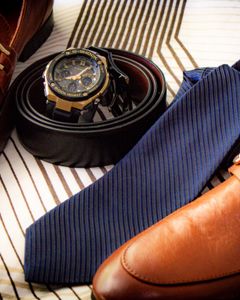
Belt and shoes should be close in tone. Not identical — close. This is the convention most frequently ignored and the one most visible when broken, because both sit in the same field of view.
Socks bridge trousers and shoes. The traditional guidance is to match socks to the trousers, not the shoes, which maintains an unbroken line down the leg. White sports socks with anything other than sportswear is the single most common error in the entire subject.
Also by Gil Mowatt
- The four alterations that change everything, and what they should costFit & Tailoring
- How a jacket should fit, starting with the only part you cannot changeFit & Tailoring
- How shoes are built, and why it determines whether they can be repairedShoes & Accessories
- Trouser length: the detail everyone notices and nobody mentionsFit & Tailoring