Shoes & Accessories
Scarves, ties and pocket squares: the optional things worth doing
Nothing here is necessary, which is exactly why it registers. A tie choice and a scarf fold are among the few visible decisions left in most wardrobes.
Ties have become optional in most contexts and are therefore, when worn, a clear signal of intent. The same is true of a pocket square and of a deliberately chosen scarf.
Ties
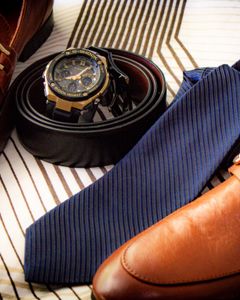
Width should relate to the lapel of the jacket it is worn with. A narrow lapel with a wide tie looks unbalanced and vice versa. Around 7 to 8.5 cm is the versatile middle and works with most current lapels.
Length. The tip should reach the middle of the belt buckle or waistband. Too short is the more visible error.
Construction. A good tie is cut on the bias from three pieces, which allows it to hang straight and recover its shape after being knotted. A slip stitch — a loose thread running the length of the tie inside — allows it to give and return; you can find it by gently pulling the two ends apart and feeling for the give.
Lining determines weight and knot size. Heavier lining produces a larger knot.
Unlined and untipped ties — where the fabric is folded rather than lined — are lighter, produce a smaller knot with a characteristic soft dimple, and are typically Neapolitan in origin.
Knots
Four-in-hand. Small, slightly asymmetric, quick. The most versatile and the one most well-dressed people actually use. Works with almost every collar.
Half-Windsor. Medium, symmetric, triangular. Good for spread collars and lighter ties.
Full Windsor. Large, wide, very symmetric. Requires a wide spread collar and a longer tie. Frequently overused, and it looks bulky with a heavy tie or a narrow collar.
Pratt or Shelby. Between the four-in-hand and half-Windsor in size.
The dimple — the small fold below the knot — is created by pinching the tie just under the knot as you tighten. It is not compulsory and it does make a tie look considered rather than pulled on.
Vary the scale. A patterned shirt takes a tie with a clearly different pattern scale, or a plain one.
Share a colour between tie and shirt or tie and jacket, and the outfit coheres.
Contrast the value. A tie darker than the shirt is the reliable default; a tie lighter than the shirt is difficult.
Texture beats pattern for versatility — a knitted or grenadine tie works with almost anything.
Pocket squares
Purely decorative and, for that reason, one of the clearest indicators that someone dressed deliberately.
Do not match your tie. A matching tie-and-square set reads as a bought package. The square should relate to the outfit — picking up a secondary colour from the tie or the shirt — without matching anything exactly.
Folds:
- Presidential — a straight horizontal edge showing about a centimetre. Formal, crisp, works with linen or cotton.
- Puff — pinched in the centre, tucked in, arranged loosely. Casual and easy, and best in silk.
- One-point or two-point — folded to show one or two triangular tips. Between the two in formality.
Materials. Linen and cotton hold a crisp fold and are appropriate for structured folds. Silk is soft and suits a puff. Wool and cashmere squares work with tweed and flannel in winter.
With black tie, a white linen square, presidential fold. That is the one place the rule is genuinely fixed.
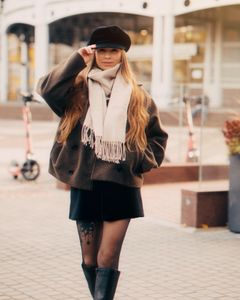
Scarves
The most useful accessory in most wardrobes and the least considered.
Warmth versus decoration. Wool and cashmere for warmth, silk for decoration, cotton and linen for summer. A silk scarf worn for warmth is doing very little.
Length determines what you can do. Around 180 cm allows most wrapping styles. Under 150 cm limits you to a drape or a single loop.
The drape. Simply hung around the neck, both ends front. Works under a coat and takes no effort.
The once-around. One loop, ends hanging. The most common.
The Parisian or slip knot. Fold in half, place around neck, pass the loose ends through the loop. Neat, secure, and the most useful for a long scarf.
The ascot fold. Crossed at the front and tucked into a coat. Dressier.
A scarf sits directly next to the face, which makes it the best place in an outfit for a colour that flatters you — and a good solution if you want to wear a colour elsewhere that does not.
The general point
None of these are required. Which is why they are noticed.
An outfit with one deliberate optional element — a knitted tie, a linen square, a scarf that picks up the coat lining — reads differently from the same outfit without it, and the difference costs very little and takes ten seconds.
Also by Gil Mowatt
- The four alterations that change everything, and what they should costFit & Tailoring
- How a jacket should fit, starting with the only part you cannot changeFit & Tailoring
- How shoes are built, and why it determines whether they can be repairedShoes & Accessories
- Trouser length: the detail everyone notices and nobody mentionsFit & Tailoring