Colour & Pattern
Accent colour: the small dose that changes an outfit
A neutral wardrobe becomes interesting through one deliberate colour in a small quantity. The proportion matters more than the colour, and most people use too much.

An accent is a colour used in a small proportion of an otherwise neutral outfit. It does two things: it draws the eye to a chosen place, and it signals that the outfit was assembled rather than defaulted to.
Proportion
The 60-30-10 principle, borrowed from interior design, transfers well.
60 per cent dominant — usually neutral, typically the trousers and outer layer. 30 per cent secondary — the top or knit. 10 per cent accent.
Ten per cent is a scarf, a pair of shoes, a bag, a knitted tie, a pocket square, or a single visible layer. It is not a coat.
The commonest error is using an accent colour at 30 or 40 per cent, at which point it stops being an accent and becomes a second dominant colour competing with the first.
Placement
An accent draws the eye. Where you put it is therefore a decision about where you want people to look.
Near the face — a scarf, a collar, earrings, a knit. Draws attention upward, which is generally what you want, and puts a flattering colour where reflected light affects the skin.
At the feet — coloured shoes. Draws the eye down, which lengthens the outfit visually by extending the line but pulls attention away from the face.
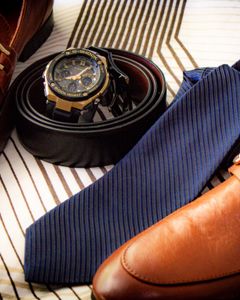
At the waist — a belt. Draws attention to the waist and breaks the vertical line, which is useful if you want to define a waist and unhelpful if you want length.
Carried — a bag. Moves with you and is the least fixed placement.
A single accent can look like it wandered in. The same accent appearing twice reads as deliberate — a rust scarf with rust in the sock, a green bag with a green detail in the shirt.
Twice is the sweet spot. Three or more times starts to look coordinated in a heavy way.
Choosing the colour
Test it against your neutrals. An accent has to work with the base, and a rust that looks excellent with camel may be muddy against charcoal. Lay them together in daylight.
Match the saturation. The single most common failure. A muted, dusty neutral base with a vivid saturated accent looks discordant. A dusty base with a dusty accent works.
Pick two or three accents for a wardrobe rather than many, chosen so that all of them work with all your neutrals. This is what makes an accent wardrobe function combinatorially rather than requiring a decision each time.
Accents that work with common bases
With navy: rust, mustard, burgundy, forest green, coral, white.
With grey: almost anything, since grey is genuinely neutral. Burgundy, teal, mustard and blush are reliable.
With camel and brown: olive, rust, cream, burgundy, deep blue.
With olive: rust, cream, burgundy, navy, orange.
With black: high-saturation colours work because the contrast is already maximal — true red, cobalt, emerald.
The metal accent
Under-considered. Gold reads as a warm accent and silver as a cool one, and jewellery, hardware, buttons and watch cases all contribute.
An outfit with consistent metal reads as more coherent, and a metal that matches the wardrobe's temperature — gold with warm neutrals, silver with cool — is a small, free improvement.
When to skip it
An accent is not required. Fully neutral outfits work, particularly tonal ones where texture carries the interest.
And there are contexts where drawing the eye is unhelpful: interviews, funerals, situations where you want the clothing not to register. Neutral throughout is the correct answer there, and it is a choice rather than a failure.
The practical starting point
For anyone with a neutral wardrobe that feels flat, the cheapest intervention is a scarf.
It sits next to the face where colour does the most, it costs a fraction of any garment, it can be removed, and it changes an outfit more visibly than anything else of comparable cost. Two or three in colours that work with your base neutrals will do more than any single new garment.
Also by Noor Haddad
- Building a capsule wardrobe by subtraction rather than purchaseCapsule Wardrobe
- Cost per wear: the only shopping arithmetic worth doingShopping Smart
- Why some colours suit you: contrast and undertone, without the seasonsColour & Pattern
- Buying clothes secondhand online without being disappointedShopping Smart