Fabric & Care
Why Wool Needs Rest More Than It Needs Washing
Wool fibers recover their shape and shed odor on their own given time and air, which is why the fiber tolerates infrequent laundering better than any other.

Wool garments are laundered far more often than they need to be. The fiber has properties that handle both odor and creasing without water, provided it is given the conditions to do so.
The fiber has a natural crimp
Wool fibers are not straight. They have a waved structure that behaves like a spring, which is why wool fabric returns to shape after being compressed or creased.
Recovery is not instantaneous. The fiber relaxes back over hours, and it does so faster in slightly humid air than in dry air.
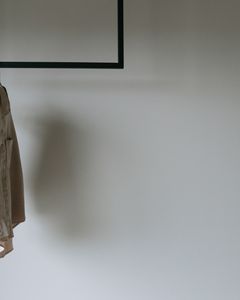
Hanging a wool garment overnight allows most creasing from a day of wear to disappear, which is the same mechanism that makes steaming effective.
Odor comes from bacteria, not from fabric
Clothing smells because bacteria metabolize compounds in sweat, and the odor is a product of that activity rather than of the sweat itself.
Wool absorbs moisture into the fiber interior rather than holding it at the surface, so the surface stays drier and supports less bacterial growth.
This is why a wool garment worn for several days can smell unremarkable while a synthetic worn once does not, despite the synthetic drying faster to the touch.
Air movement completes the process
Resting works because moisture leaves the fiber and the garment returns to equilibrium with the room. Trapped in a closet against other garments, it does neither.
Space on the rail, or a few hours on a hanger somewhere with moving air, is the difference between a garment that recovers and one that does not.
Twenty-four hours between wearings is the general rule, which conveniently matches the rotation that also extends the life of the garment.
Washing is what causes most wool damage
Wool fibers have overlapping scales along their length. Under heat, moisture and agitation together those scales lock into one another, which is felting.
Felting is permanent and is what produces a shrunken, dense sweater. It requires all three conditions, which is why cold water and no agitation makes hand washing safe.
Every wash cycle avoided is therefore a real extension of the garment's life rather than a shortcut, which is not true of most other fibers.
Spot treatment handles the rest
Most of what sends a wool garment to be cleaned is a single mark rather than general soiling of the whole piece.
Treating that spot with a damp cloth, working from the outside inward, addresses the actual problem without subjecting the rest of the garment to a cleaning process.
A brush also matters more than it sounds. Wool holds surface dust and lint in its nap, and removing that mechanically restores appearance without any moisture at all.
Also by Noor Haddad
- Building a capsule wardrobe by subtraction rather than purchaseCapsule Wardrobe
- Cost per wear: the only shopping arithmetic worth doingShopping Smart
- Why some colours suit you: contrast and undertone, without the seasonsColour & Pattern
- Buying clothes secondhand online without being disappointedShopping Smart