Capsule Wardrobe
Building A Capsule Around One Pair Of Shoes
Choosing footwear first constrains a wardrobe usefully, because shoes set formality and colour more rigidly than clothing and are the hardest item to duplicate.

Most capsules are built from clothing outward, with shoes chosen last. Reversing that produces a tighter set, because footwear is the least flexible thing in a wardrobe.
Shoes are the least adjustable element
A shirt can be layered, tucked or rolled to change its register. A shoe is what it is, and it drags every outfit toward its own level of formality.
That rigidity makes footwear a good foundation. Choosing it first means every clothing decision afterwards is made against a fixed point rather than a moving one.
It also prevents the common failure of assembling clothes that work together and then discovering nothing owned goes on the feet with them.
The single pair has to sit in the middle
A one-shoe capsule cannot use an extreme. A formal shoe will not survive a weekend and a running shoe will not survive an office, so the choice is a middle option.
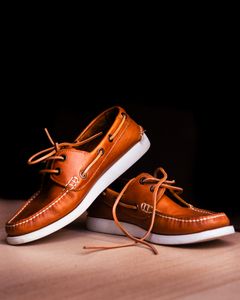
Plain leather shoes with a substantial sole, or a clean minimal leather trainer, occupy that middle. Neither is the best shoe for any single occasion, which is the trade.
Colour follows the same logic. A mid or dark brown, or black in a wardrobe already built on black, disappears rather than announcing itself under every outfit.
Trouser length becomes a fixed measurement
Hem length is set relative to a specific shoe, because sole thickness changes where the trouser breaks. One pair of shoes means one hem length across the whole wardrobe.
This is a genuine practical gain. Every pair of trousers can be altered to the same measurement and will look correct every time it is worn.
Wardrobes with several shoe heights never quite achieve this. Trousers hemmed for one pair look slightly wrong with another, and the difference is visible without being nameable.
One pair wears out fast
Concentrating all wear into a single pair shortens its life considerably. Leather needs a day to dry out between wearings, and shoes worn daily compress and crease faster.
This argues for a construction that can be resoled, so the pair can be renewed rather than replaced. It is the case where paying more genuinely changes the arithmetic.
It also argues for a second, identical pair once the approach has proved itself. Rotating two of the same shoe is still a one-shoe wardrobe in every respect that matters.
The exceptions should be named, not smuggled
Weather and specific activities will defeat any single pair. Snow, heavy rain and sport all require something the middle-ground shoe cannot do.
Naming those exceptions and owning exactly one item for each keeps the system honest. What breaks a capsule is unnamed additions, not acknowledged ones.
Kept that way the wardrobe still runs on one pair for ordinary life, with a small, explicit set held back for the conditions that genuinely demand it.
Also by Noor Haddad
- Building a capsule wardrobe by subtraction rather than purchaseCapsule Wardrobe
- Cost per wear: the only shopping arithmetic worth doingShopping Smart
- Why some colours suit you: contrast and undertone, without the seasonsColour & Pattern
- Buying clothes secondhand online without being disappointedShopping Smart