Shoes & Accessories
Belts: Width, Buckle And Matching Without Matching
A belt's width and hardware set its formality more than its colour does, and the rule about matching shoes is narrower than it is usually stated.
Belts are chosen almost entirely by colour, which is the least informative of their attributes. Width and buckle decide whether one belongs with an outfit at all.
Width sets the register
A narrow belt reads formal and a wide one reads casual, and the transition is fairly sharp. The dividing line sits around the point where a belt stops fitting dress trouser loops.
This is not arbitrary. Formal trousers have narrow loops, so a wide belt physically cannot be worn with them, and the convention follows the construction.
Casual trousers and jeans have wider loops and heavier fabric, which a narrow belt looks insubstantial against. The belt should be proportionate to what it is holding.
The buckle carries the formality signal
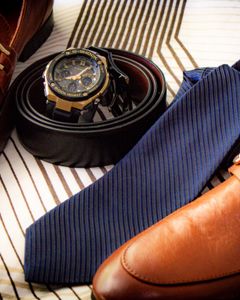
A small, plain, single-prong buckle in a subdued finish is the formal option. Larger buckles, double prongs, visible branding and heavy hardware move steadily toward casual.
Finish matters as much as size. A polished buckle reads dressier than a brushed or matte one, and a blackened or antiqued finish reads more rugged than either.
Because the buckle is the most visible part, it drives the impression more than the leather does. A plain buckle rescues an otherwise casual belt more often than the reverse.
Matching shoes is about tone, not shade
The convention that belt and shoes should match is really about them being in the same family. Identical shade is neither achievable nor necessary across different leathers.
A mid-brown belt sits comfortably with a range of brown shoes. What clashes is a warm reddish brown against a cool grey-brown, or a black belt against tan shoes.
The rule also loosens outside formal dress. With casual clothing, a belt that contrasts deliberately reads as a choice rather than an error.
Construction determines how long it lasts
Full-grain leather belts are cut from a single hide and wear by softening and creasing. Bonded leather belts are made of shredded fibre and delaminate rather than age.
The edge is the fastest tell. A finished, burnished edge with visible layers indicates solid leather; a smooth, uniform painted edge often conceals a composite core.
Stitching along the length usually indicates two layers bonded together, which is normal in dress belts. An unstitched single thickness is typical of heavier casual belts.
Fit is a hole position, not a waist size
A belt should fasten on its middle hole with the tail reaching roughly the first loop. Fastening on the last hole means the belt is too long and the excess will flap.
Belt sizing is usually measured to the middle hole rather than to the tip, which is why buying by trouser waist size produces a belt slightly too small.
A leather belt can be shortened from the buckle end by a repairer, which preserves the tip shape. It is a cheap alteration and it makes an inherited or mis-sized belt usable.
Also by Noor Haddad
- Building a capsule wardrobe by subtraction rather than purchaseCapsule Wardrobe
- Cost per wear: the only shopping arithmetic worth doingShopping Smart
- Why some colours suit you: contrast and undertone, without the seasonsColour & Pattern
- Buying clothes secondhand online without being disappointedShopping Smart