Fit & Tailoring
Suits: when to wear one, and how to make it look intentional
Fewer people wear suits daily, which has made the suit more conspicuous rather than less. Worn well it reads as deliberate; worn badly it reads as an obligation.
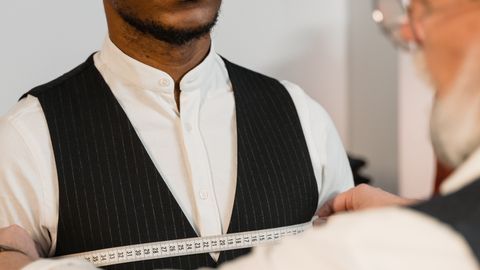
The decline of the daily suit has changed what wearing one means. It used to be the default; it is now a choice, and choices are noticed.
The colours that work
Navy is the most versatile suit colour and the one to buy first. It flatters most complexions, works in business and social contexts, and takes brown or black shoes.
Charcoal is the second. More formal than navy, appropriate for anything sombre, and works with black shoes particularly.
Mid-grey is lighter and slightly less formal.
Black is the least versatile business suit despite being what many people buy first. It is genuinely formal and reads as funereal or as waiting staff in daytime business settings. Its proper place is evening and formal occasions.
Patterns — chalk stripe, glen check, birdseye — reduce versatility because they are memorable. Buy plain first.
The construction question
Covered in more detail elsewhere, and worth stating in short.
Check whether the jacket is fused, half-canvassed or full canvas by pinching the front between the buttonholes and the lining and rolling the layers. A separate floating layer means canvas.
Fused jackets can bubble irreparably after repeated cleaning. Half-canvas is a reasonable compromise. Full canvas moulds to the body and lasts decades.
This matters more than the label and more than the price.
Never fasten the bottom button of a two- or three-button jacket. Fasten the top button of a two-button, the middle of a three-button.
Unbutton when you sit and refasten when you stand. A fastened jacket while seated pulls at the button and distorts the front.
No belt with a suit traditionally — trousers should fit at the waist, with side adjusters or braces. This one is widely ignored and worth knowing.
Remove the basting stitches holding the vents and pockets closed on a new jacket, and the label sewn on the sleeve. This is the single most common oversight.
Fit priorities
Shoulders first — unfixable. Then chest, then jacket length, then everything else.
The two errors visible from across a room are shoulders that do not fit and sleeves that are too long. The first cannot be fixed and the second costs very little.
Trousers should sit at the waist without a belt, and be hemmed wearing the shoes you will wear.
Making it less formal
The most useful modern skill, since full formality is rarely required.
Remove the tie and open the top button. The single largest step down.
Change the shirt. An oxford cloth shirt, a fine knit polo, or a plain t-shirt under the jacket each reduce formality progressively.
Change the shoes. Loafers, suede derbies or minimal leather trainers.
Choose a softer suit. Unstructured shoulders, patch pockets, a softer fabric like flannel, hopsack or cotton. These read as tailoring rather than as business dress.
Texture over smooth. A worsted wool business suit is difficult to dress down. Flannel, tweed, linen and cotton are far easier.
Separates
Wearing a jacket with different trousers is where most people get the most use out of tailoring, and there are two things to get right.
The jacket must look like a jacket, not like an orphaned suit top. Suit jackets are cut and finished to match their trousers, and worn alone they frequently look like half a suit. Jackets designed as separates — sports coats, blazers — have more texture, patch pockets, more colour, and softer construction.
Contrast enough. A navy jacket with slightly different navy trousers looks like a mistake. Either contrast clearly — navy jacket, grey trousers — or contrast in texture as well as tone.
Care
Dry clean rarely — two to four times a year at most for a regularly worn suit. Dry cleaning is harsh on both the cloth and the internal construction.
Brush and steam instead. A clothes brush after each wear removes surface dirt. A steamer or a hanging in a steamy bathroom removes creases and refreshes the cloth.
Rest it. Wool recovers its shape given 24 hours. Wearing the same suit daily wears it out considerably faster.
Hang on a wide, shaped wooden hanger. Never wire.
Trousers on a clamp hanger from the hem, so gravity keeps the crease.
Repair promptly. A tailor can replace a lining, reinforce a seat, patch elbows and mend a trouser crotch. A suit that fits is worth maintaining well past the point most people discard one.
Also by Gil Mowatt
- The four alterations that change everything, and what they should costFit & Tailoring
- How a jacket should fit, starting with the only part you cannot changeFit & Tailoring
- How shoes are built, and why it determines whether they can be repairedShoes & Accessories
- Trouser length: the detail everyone notices and nobody mentionsFit & Tailoring