Fit & Tailoring
What a bespoke suit involves, and whether it is worth it
Bespoke, made-to-measure and off-the-peg describe three genuinely different processes, and the terms are used interchangeably by people selling the cheaper one.
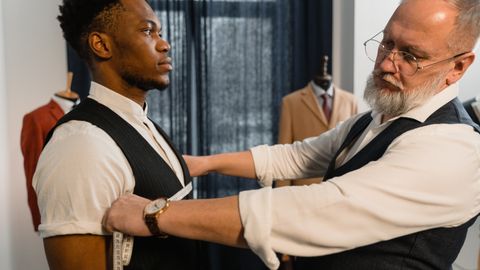
The vocabulary here is abused constantly. The three categories are distinct, and the differences are in process rather than in price.
Off-the-peg (ready-to-wear)
Made in standard sizes from a graded pattern. You buy the nearest size and alter it.
Quality varies enormously — a well-made ready-to-wear suit from a good maker will be better constructed than a badly executed made-to-measure one. Alterations can achieve a great deal, and for most people a good off-the-peg suit properly altered is the sensible answer.
Made-to-measure
A block pattern — the maker's existing base pattern — is adjusted to your measurements. Chest, waist, sleeve length, jacket length, trouser measurements, and typically a limited set of postural adjustments such as a sloping shoulder or a prominent seat.
You choose the cloth, the lining, the buttons, the lapel style, the vents, the pockets.
What it is not: a pattern created for you. The underlying architecture is the maker's house cut, adjusted. Which means if the house cut does not suit your build, made-to-measure will improve the fit without fixing the underlying shape.
Usually one fitting, sometimes none. Turnaround typically four to eight weeks.
A unique pattern is drafted for you from scratch, based on measurements and observation of your posture, and cut by hand. The garment is basted together and fitted on your body, then taken apart and adjusted — usually two to four fittings, sometimes more.
The distinguishing features: a paper pattern that exists only for you and is kept for future orders, hand-cutting, and iterative fittings on a partially constructed garment.
Turnaround is typically two to six months. Savile Row houses will make three or more fittings standard.
The canvas, which matters more than the label
Underneath the outer cloth of a jacket there is an interlining that gives it shape. How it is attached is the single biggest structural quality difference in tailoring, and it is invisible.
Fused. The interlining is glued to the outer cloth with heat. Cheap, fast, and produces a flat, slightly stiff front. Over years, and particularly with dry cleaning, the adhesive can fail and the front bubbles — irreparable.
Half-canvassed. A floating canvas through the chest and lapels, fused below. A reasonable compromise and common in mid-price suits.
Full canvas. A layer of horsehair and wool canvas runs the full length of the front, attached only by stitching so it floats between the outer cloth and the lining. It moulds to your chest over time, produces a rolling lapel rather than a flat pressed one, and lasts decades.
How to check: pinch the front of the jacket between the buttonholes and the lining, and try to separate the layers by rolling them between your fingers. If you can feel a distinct third layer moving independently, it is canvassed. If it feels like one bonded sheet, it is fused.
What bespoke actually buys you
Fit for an unusual build. The strongest case. Significant posture asymmetry, a dropped shoulder, a very long or short torso, a large difference between chest and waist — these are the situations where a drafted pattern is genuinely necessary rather than a luxury.
The armhole. A high, small armhole cut for your body allows the arm to move without the jacket lifting. This is the difference experienced wearers notice most and it is very difficult to achieve off the peg.
Cloth choice. Access to a far wider range of cloth than ready-to-wear offers.
Longevity. The pattern is kept, so subsequent commissions are faster, and a full-canvas hand-made garment can be repaired and altered extensively over decades.
What it does not buy you
A guaranteed result. Bespoke depends entirely on the individual cutter. A poor bespoke tailor produces a worse garment than a good ready-to-wear house.
Instant comfort. A first bespoke commission frequently requires adjustment after wearing, and the relationship with a tailor improves over several garments.
Obvious visible difference to others. Most people cannot identify a bespoke suit. The benefit is how it fits and moves, not how it is recognised.
Choosing where to spend
A reasonable progression for most people:
First, a well-made off-the-peg suit in a full or half-canvassed construction, properly altered. This will handle most needs and costs a fraction of the alternatives.
Then, if you wear suits frequently and the ready-to-wear fit is consistently poor, made-to-measure from a maker whose house cut suits you.
Then bespoke, if fit remains a problem or if you want the specific thing it offers.
The order that wastes money is the common one: buying an expensive designer suit off the peg, wearing it unaltered, and concluding that expensive suits do not fit any better.
Questions to ask
Is it fused, half-canvassed or full canvas? How many fittings? Is the pattern drafted individually or adjusted from a block? Where is it made? What happens if it does not fit at the final fitting?
An honest maker answers all of these directly. Evasion on the first or the third is the signal to leave.
Also by Gil Mowatt
- The four alterations that change everything, and what they should costFit & Tailoring
- How a jacket should fit, starting with the only part you cannot changeFit & Tailoring
- How shoes are built, and why it determines whether they can be repairedShoes & Accessories
- Trouser length: the detail everyone notices and nobody mentionsFit & Tailoring