Fit & Tailoring
Fixing common fit problems with what you already own
Before buying anything, most wardrobes contain several garments that are almost right. Here is what a tailor can do about each of the usual complaints, and roughly what it involves.
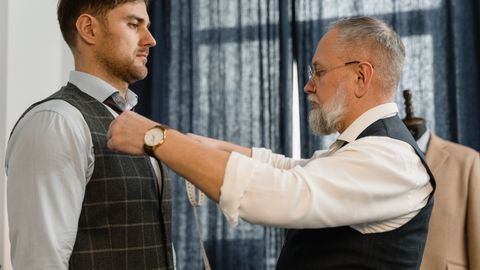
The most cost-effective wardrobe improvement available is usually not a purchase. It is taking three or four almost-right garments to a tailor.
Here is what is fixable, what is not, and what each involves.
Jackets
Sleeves too long — the commonest and among the cheapest. Shortened from the cuff. If the buttonholes are functional, it must be done from the shoulder, which is considerably more work.
Too loose through the waist — the side seams and centre back seam are taken in. Usually possible by a few centimetres. Fully achievable.
Too tight — depends entirely on inlay. Check the seam allowances inside; some jackets have generous inlay and can be let out, many have almost none.
Too long in the body — can be shortened a little from the hem, and only a little, because it moves the pockets and the button stance out of proportion. More than 2–3 cm usually looks wrong.
Collar gapping at the back — a balance problem, frequently caused by posture. A good tailor can adjust the collar and the back balance; a mediocre one cannot. Worth asking specifically whether they do this.
Shoulders wrong — not economically fixable. This is the buying decision.
Before buying anything you might want to let out, look at the inside seam allowances. Generous inlay — 2 cm or more at the side seams and centre back — means the garment can be adjusted in both directions. Narrow allowances mean it can only be taken in.
Better manufacturers leave inlay deliberately because they expect the garment to be altered and kept.
Trousers
Waist too big — taken in at the centre back seam. Straightforward, usually up to 4–5 cm.
Waist too small — let out if there is inlay, which most trousers have at the centre back for exactly this reason.
Legs too wide — tapered from the knee down. Cheap and one of the most transformative alterations available. Tapering from the hip involves the seat and the pockets and is a different job.
Too long — hemmed. The cheapest alteration there is. Have it done wearing your actual shoes.
Seat too tight — some adjustment possible at the seat seam if there is inlay. Look for horizontal pull lines and gaping back pockets as the diagnostic.
Crotch too low — the rise cannot practically be shortened without rebuilding the trousers. This is a buying decision.
Shirts
Too billowy — side seams taken in, or darts added at the back. Very cheap and dramatically improves how a shirt looks under a jacket.
Sleeves too long — shortened at the cuff, which involves detaching and reattaching it. Moderate cost.
Collar too tight — not fixable. The collar is the size it is.
Too short in the body — not fixable.
Coats
Sleeves too long — shortened, taking the lining into account.
Too loose — taken in at the side seams and centre back, with the lining adjusted to match. More work than a jacket because of the lining and the weight of the cloth.
Too long — can be shortened, though it changes the proportion and, on a coat with pockets set low, can look wrong.
Dresses and skirts
Hem length — straightforward, and one of the highest-impact changes available since hem length determines proportion.
Straps too long — shortened, cheap.
Waist and side seams — taken in, straightforward on simple constructions and more involved where there are linings, zips or complex seaming.
Bust darts in the wrong place — repositioning is possible and involves substantial reconstruction. Frequently not worth it.
Knitwear
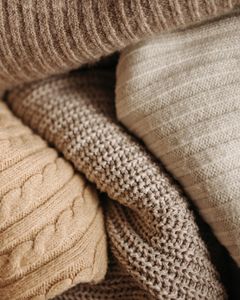
Generally the least alterable category, because cutting knitted fabric causes it to unravel.
Sleeves and body length can sometimes be shortened by a specialist who can re-knit or re-link the ribbing. Not all tailors do this.
Stretched cuffs and hems can occasionally be revived by careful washing and reshaping while damp, and permanently stretched ribbing usually cannot be restored.
The order to work in
Go through the wardrobe and pull out anything unworn because something is slightly wrong. Try each on and identify the specific problem.
Take the whole batch to a tailor at once — most will quote on the lot and it is a single trip.
Start with the cheap fixes: hems, tapers, sleeve shortening, taking in a shirt. These are inexpensive individually and account for most of the improvement.
Then consider whether the more expensive alterations are justified by the garment. A £40 jacket does not warrant a £60 alteration; a coat you will wear for a decade does.
The judgement call
A good tailor will tell you when something is not worth altering. That advice is worth having, and a tailor who says yes to everything without examining the garment is not the one to use.
Also by Gil Mowatt
- The four alterations that change everything, and what they should costFit & Tailoring
- How a jacket should fit, starting with the only part you cannot changeFit & Tailoring
- How shoes are built, and why it determines whether they can be repairedShoes & Accessories
- Trouser length: the detail everyone notices and nobody mentionsFit & Tailoring