Shoes & Accessories
Buying shoes that fit, which is not the same as your size
Length is one of four dimensions and the only one most people consider. Width, instep height and heel volume determine whether a shoe is comfortable, and none of them appear on the box.
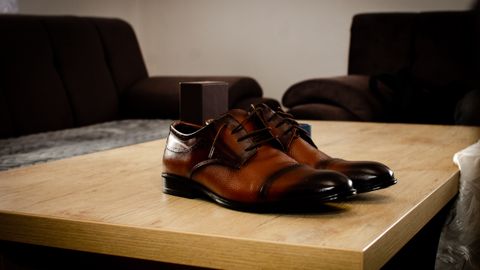
Shoe sizing systems are inconsistent between countries and between manufacturers, and even within a single system the number describes length only. Everything else about fit is determined by the last — the wooden or plastic form the shoe is built around — and lasts differ enormously.
The four dimensions
Length. There should be roughly a centimetre to a centimetre and a half between the longest toe and the end of the shoe when standing. Note that the longest toe is not always the big toe.
Width. The ball of the foot should sit at the widest part of the shoe without pressure at the sides. Width fittings — D, E, EE, or narrow, standard, wide — exist and are ignored by most retailers, which is why so many people wear shoes that are the right length and too narrow.
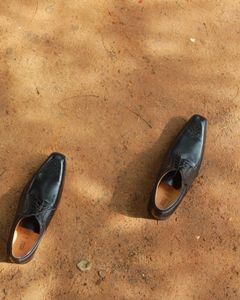
Instep height. The volume over the top of the foot. A high instep in a low-volume shoe produces pressure across the top and is a common cause of discomfort in oxfords, which have closed lacing and cannot open further. Derbies, with open lacing, accommodate a high instep far better — which is a genuine practical reason to prefer them.
Heel volume. The heel should be held firmly with minimal slipping. Some slip in a new leather-soled shoe is normal and reduces as the sole flexes; persistent slipping means the heel cup is too large.
Measure both feet, standing, in the afternoon when feet are at their largest, wearing the socks you intend to wear.
Most people have one foot noticeably larger — fit to the larger one. And foot size changes through adulthood: feet lengthen and widen with age, and after pregnancy. A size you have used since your twenties may be wrong.
Lasts and shape
Two shoes in the same size on different lasts fit completely differently.
Toe shape — round, almond, chisel, square. This affects where your toes sit and how much length you need. A very pointed last requires a longer shoe to accommodate the same foot.
Toe spring — the upward curve at the front. More spring makes walking easier and reduces effective interior length.
Heel-to-ball length. The most important and least discussed measurement. It is the distance from the heel to the widest part of the foot, and it determines where your foot flexes relative to where the shoe flexes. If the two do not align, the shoe creases in the wrong place and is uncomfortable regardless of overall length.
This is why some people find a particular brand fits and another does not, at the same size — the lasts have different heel-to-ball proportions.
Trying them on properly
Both shoes, both on, standing and walking. Not one shoe, sitting down, which is what most people do.
Walk on a hard surface if possible, not just the shop carpet.
Check for pressure points at the little toe joint, across the instep, at the back of the heel and at the ball.
Do not rely on breaking in. Leather stretches slightly in width and barely at all in length. A shoe that is too short will always be too short. A shoe that is slightly snug across the width may improve; one that is painfully tight will not.
The half-size problem
Shoes are made in half sizes, and feet are not. A foot between sizes has two poor options, and the practical solutions are:
Size up and use an insole to take up volume. A full-length thin insole is better than a heel grip for this.
Different lasts. A slightly roomier last in the smaller size may fit better than the larger size in a slim last.
Width fittings where available — going up a width rather than a length is frequently the right answer for someone whose feet are broad rather than long.
Common fit problems and their causes
Heel slipping. Heel cup too large, or the shoe is too long overall. A heel grip helps mildly; the real fix is a different last.
Pressure on the little toe. Too narrow, or a toe shape that does not match your foot.
Pain across the instep. Volume too low. Open-laced shoes accommodate this; closed-laced ones cannot.
Toes hitting the end when walking downhill. Too short, or heel slipping is allowing the foot to slide forward.
Creasing across the vamp in the wrong place. Heel-to-ball mismatch. The shoe is flexing where your foot does not.
Stretching and adjustment
A cobbler can stretch leather shoes in width by a small amount, and can spot-stretch a specific pressure point over a bunion or a joint. This works and is limited — typically a few millimetres.
Length cannot be added. Synthetic uppers cannot be stretched meaningfully.
Which returns the whole matter to buying correctly: a shoe that is nearly right can be improved, and a shoe that is the wrong length or the wrong last shape cannot be rescued.
Also by Gil Mowatt
- The four alterations that change everything, and what they should costFit & Tailoring
- How a jacket should fit, starting with the only part you cannot changeFit & Tailoring
- How shoes are built, and why it determines whether they can be repairedShoes & Accessories
- Trouser length: the detail everyone notices and nobody mentionsFit & Tailoring