Shopping Smart
Second-hand shops: how to find the good things quickly
Charity and thrift shops contain a small amount of excellent clothing distributed through a large amount of ordinary clothing. Finding it is a search problem with a reasonably efficient solution.
The economics are straightforward: donated clothing is priced by volunteers on the basis of appearance and brand recognition, not construction. Which means genuinely well-made clothing from unfamiliar makers is regularly under-priced, and recognisable brands are regularly over-priced.
Everything below follows from that.
Search by touch, not by eye
The single most useful technique.
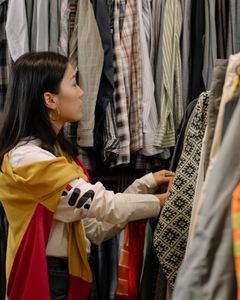
Walk the rail with your hand out, touching the fabric of each garment rather than looking at each one. Good fabric feels different — heavier, denser, with a distinctive hand. Wool, cashmere, silk, linen and heavy cotton are all identifiable by touch within a second.
This is roughly ten times faster than looking, and it filters for the variable that matters most.
When something feels right, then look at it.
Check the label second
Fibre composition, not brand. A 100 per cent lambswool jumper from a maker nobody has heard of is a better find than a wool-acrylic blend from a name.
Country of manufacture is weakly informative — older British, Italian, Scottish and Japanese manufacture frequently indicates a period when production standards were higher.
Union labels and old-style care labels can date a garment, and older garments are frequently better constructed.
Sizing has drifted substantially — a garment labelled 12 from the 1990s is closer to a modern 8. Vintage sizing runs smaller still.
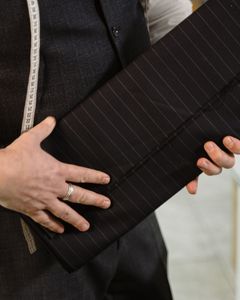
Carry your measurements. Better still, carry a small tape measure, which costs almost nothing and removes all guesswork.
Check condition properly
The failure points, in the order they matter.
Underarms. Yellowing, thinning and odour. Deodorant staining in the underarm of a shirt is frequently permanent.
Collars and cuffs. Fraying and grey marking.
The seat and crotch of trousers. Thinning and shine.
Elbows. Thinning in knitwear and jackets.
Moth holes. Small irregular holes in wool, particularly near seams and folds. Hold knitwear up to the light.
Zips and fastenings. Run every zip. A broken zip is a repairable but real cost.
Smell. Cigarette smoke and mildew are the two that are extremely difficult to remove. Sniff anything before buying, and be honest with yourself about whether the smell will come out.
Where the good things are
Affluent areas have better donations. This is unsubtle and reliable.
Hospice and specialist charity shops frequently receive whole-wardrobe donations and price conservatively.
The menswear section in general — it is smaller, less picked over, and contains proportionally more tailoring and knitwear.
The wrong section. Volunteers sort by appearance and get it wrong regularly. Oversized menswear appears in the women's section and vice versa, and good knitwear frequently ends up filed by colour rather than by size.
The unfashionable rails. Where nobody is looking.
Timing
Ask when new stock goes out. Most shops have a routine, and being there on the right morning is worth more than any other technique.
January, after clear-outs. September, after summer moves. Both produce volume.
Off-season buying — coats in July, linen in January — is where prices are lowest and competition is nil.
What is worth buying
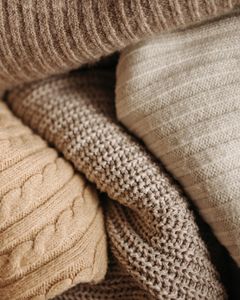
Knitwear in good natural fibres, checked for moths and pilling. Cashmere secondhand is the best value in the entire market.
Coats and jackets, where quality of construction is high and fit is forgiving.
Tailoring. Under-priced almost everywhere because fewer people wear it. Buy for the shoulders and have the rest altered.
Silk scarves, which are frequently excellent and cheap.
Leather goods, which age well.
Heavy cotton shirts from older manufacture.
What is not
Shoes, which have moulded to another foot.
Anything with elastane, which degrades with age regardless of use and will have lost its recovery.
White and cream, where age yellowing is common and frequently permanent.
Anything needing significant alteration unless it is genuinely special, because the alteration will cost more than the garment.
When you get home
Quarantine everything before it enters your wardrobe. Seal it in a bag and freeze for 72 hours, or wash at the highest temperature the garment tolerates.
This kills moth eggs and larvae, and a single infested jumper introduced into a wardrobe of woollens is an expensive mistake that is entirely avoidable with one bag and a freezer.
Also by Noor Haddad
- Building a capsule wardrobe by subtraction rather than purchaseCapsule Wardrobe
- Cost per wear: the only shopping arithmetic worth doingShopping Smart
- Why some colours suit you: contrast and undertone, without the seasonsColour & Pattern
- Buying clothes secondhand online without being disappointedShopping Smart