Fabric & Care
The white shirt: what separates a good one from a cheap one
The most common garment in the world, and the one where quality differences are easiest to see if you know the six details to check.
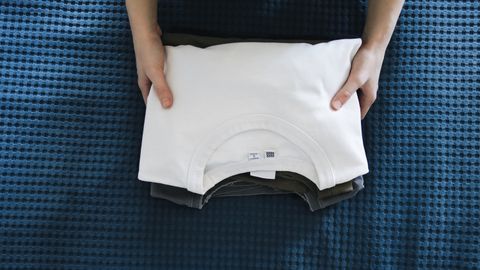
A white shirt is unforgiving. There is no colour or pattern to distract from construction, no texture to hide a poor collar, and the fabric is either opaque and crisp or it is not.
Six things separate the good from the ordinary, and all of them can be checked in a shop in under two minutes.
1. The collar
The most important component and the one cheapest to get wrong.
A good collar has an interlining — a layer of fabric between the two outer layers giving it body. Cheap shirts use fused interlining, glued in place with heat. Better shirts use a floating or sewn-in interlining, attached only at the edges so it moves with the fabric.
Fused collars are stiffer initially and eventually fail: the adhesive breaks down after repeated washing and the collar bubbles or ripples, which is irreparable and instantly visible.
How to check: pinch the collar between thumb and finger and feel for the layers. A fused collar feels like a single stiff board. A sewn-in one feels like distinct layers that can shift slightly against each other.
Also check collar height and point length. A collar too short disappears under a jacket lapel; too tall and it presses on the neck. Points that are too short leave a gap where the shirt should meet the jacket.
2. Stitch density
Count the stitches along a centimetre of a main seam.
Cheap shirts run around 5–6 stitches per centimetre. Good shirts run 8–10 or more. High density means a stronger seam, less puckering, and a cleaner line — and it takes longer to sew, which is why it correlates with everything else.
This is the fastest single quality check available on any garment.
Cheap shirts join the side seams with a single pass of a twin-needle machine, which is fast and produces puckering along the seam as the fabric is pulled from both sides.
Single-needle stitching passes the seam through the machine twice, once for each line, allowing the fabric to lie flat. The result is a completely smooth side seam. Look at the seam running down from the armpit — if it puckers, it is twin-needle.
4. Pattern matching
Not applicable on plain white, but check it on anything patterned as a proxy for how the maker works generally.
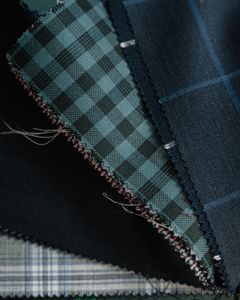
Do the stripes or checks align across the front placket? At the shoulder yoke? Where the sleeve meets the body? At the pocket, does the pattern continue as though the pocket were transparent?
Matching wastes fabric. A manufacturer willing to do it is not economising elsewhere either.
5. The gauntlet button
A small detail that reliably separates price tiers. The gauntlet is the slit on the sleeve above the cuff, and a proper shirt has a small button on it to keep the opening closed and prevent the forearm showing when the arm is raised.
Its absence is not a disaster. Its presence indicates a maker paying attention to details customers rarely notice.
6. The fabric
Look for two-ply (or "two-fold") yarn, which is stronger, smoother and less prone to pilling than single-ply.
Yarn count — 80s, 100s, 120s, 140s — measures fineness, not quality. Higher counts are softer and more lustrous and less durable. For a shirt you intend to wear weekly for years, 80s to 100s two-ply is the sensible range. 140s and above is a luxury proposition with a short life.
Hold it to the light. A shirt you can clearly see through will be transparent when worn, and white shows this worst.
Check the weave. Poplin is smooth and crisp and creases. Twill has a diagonal texture, drapes softly and resists creasing. Oxford is a basket weave, textured and durable, and reads as more casual. Royal oxford is a finer version with a subtle lustre.
Details that indicate care
Mother-of-pearl buttons rather than plastic. Heavier, with visible iridescence and slight natural variation. They also chip, which is the trade-off.
Buttons sewn with a cross or bird's-foot stitch and finished with a wrapped shank.
A split yoke — the back panel across the shoulders made in two pieces cut on the bias — which allows the shirt to follow shoulder movement. Visible as a seam running down the centre back of the yoke.
Removable collar stays, and preferably metal rather than plastic.
A gusset at the bottom of the side seams — a small reinforcing triangle. Traditional, largely decorative now, and a sign of an old-fashioned maker.
Fit, briefly
The collar should allow two fingers between it and the neck when fastened. The shoulder seam should sit at the edge of the shoulder. The cuff should be tight enough not to slide over the hand when unbuttoned — this is what stops the shirt cuff retreating up the arm inside a jacket sleeve.
Everything else — waist, sleeve length, body length — is adjustable by a tailor for very little.