Fabric & Care
Denim: raw, selvedge, sanforised, and which of it matters
The vocabulary around jeans is denser than around almost any other garment, and much of it is marketing. Three of the terms genuinely change what you are buying.
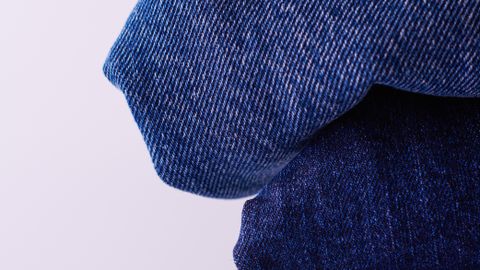
Denim is a cotton twill, traditionally woven with an indigo-dyed warp and an undyed weft. The diagonal twill structure and the fact that only one set of yarns is dyed is why denim fades the way it does — abrasion removes indigo-dyed surface fibres and exposes the white core beneath.
Raw versus washed
Raw denim has not been washed or distressed after weaving. It is stiff, dark, and will shrink and bleed. It fades according to how you wear it, developing wear patterns specific to your body and habits — the whiskers at the hip, the honeycombs behind the knee, the fade at the wallet.
Washed denim has been treated to soften it and, frequently, to simulate wear. It is comfortable immediately, does not shrink significantly, and its appearance is largely fixed.
Neither is better. Raw denim is a longer project with a personalised result. The enthusiasm around it — including advice not to wash for six months, which is aesthetic rather than hygienic — should be understood as a hobby rather than a quality standard.
Selvedge
The term causing the most confusion.
Selvedge (self-edge) denim is woven on a shuttle loom, which passes a single continuous weft yarn back and forth. Because the yarn turns at each edge, the fabric has a finished, self-bound edge that will not fray — visible as the clean band with a coloured line, usually red, when a cuff is turned up.
Modern projectile looms insert a separate length of weft each pass, leaving raw edges that must be overlocked. They are far faster and produce wider fabric.
The practical consequences of shuttle weaving:
- Narrow fabric, roughly 75 cm versus 150 cm or more, so more fabric is used per pair.
- Slower weaving under less tension, producing a slightly irregular, more textured fabric with more character in the fade.
- The finished edge, which allows the outseam to be constructed without overlocking.
It is not a measure of quality. Selvedge denim can be badly made and non-selvedge denim can be excellent. It indicates a weaving method, and it correlates with quality mainly because manufacturers who go to the trouble of shuttle weaving usually care about the rest.
It also has nothing to do with whether the denim is raw. Selvedge can be washed; raw can be non-selvedge.
Sanforised versus unsanforised
The term that will actually affect whether your jeans fit.
Sanforised denim has been pre-shrunk mechanically. It will shrink only about 1–3 per cent on first wash. Buy your size.
Unsanforised — sometimes called shrink-to-fit or loomstate — has not. It will shrink 5–10 per cent, mostly in length, on first soak. It is bought deliberately oversized and soaked before wearing, or worn raw and allowed to shrink to the body.
Buying unsanforised denim in your normal size without knowing produces jeans that no longer fit after one wash. This is the single most consequential term on the list and the one most often unmentioned.
Weight
Measured in ounces per square yard.
Under 12 oz is lightweight — comfortable immediately, drapes, wears out faster. 12–14 oz is the standard range and where most good jeans sit. 14–16 oz is heavy, takes weeks to break in, and holds a shape. Above 18 oz is a specialist proposition that will stand up on its own.
The other terms
Ring-spun yarn is spun in a way that produces slight irregularity and a more textured, characterful fabric. Open-end spinning is faster and produces a flatter, more uniform yarn. Ring-spun is generally preferred for character; it is not stronger.
Rope dyeing versus slasher dyeing describes how the warp is dyed. Rope dyeing produces a more pronounced ring-dyed effect — indigo on the surface, white core — which gives higher-contrast fades.
Slub and neppy describe deliberate irregularities in the yarn producing texture in the fabric.
Natural indigo versus synthetic. Almost all denim uses synthetic indigo, which is chemically identical and far cheaper. Natural indigo is a small specialist market.
Practical advice
Check for sanforisation before buying. If it is not stated, ask.
Wash cold, inside out, and infrequently if fade development matters to you. If it does not, wash them like any other trousers — the idea that washing ruins denim is aesthetic preference, not fabric science, and unwashed jeans do accumulate bacteria.
Expect indigo to transfer from raw denim onto pale furniture, car seats, shoes and hands. This is not a defect.
Repair rather than replace. Denim is one of the most repairable fabrics. Crotch blowouts and knee holes can be darned or patched, and a good repair extends a pair by years.
Buy for the waist and the rise. Everything else is alterable; the rise is not, and it determines proportion and comfort more than any other measurement.