Shopping Smart
Why clothes look different in the shop mirror
Retail lighting and mirrors are designed, not neutral. Knowing what they are doing is the difference between buying what suits you and buying what suited the changing room.
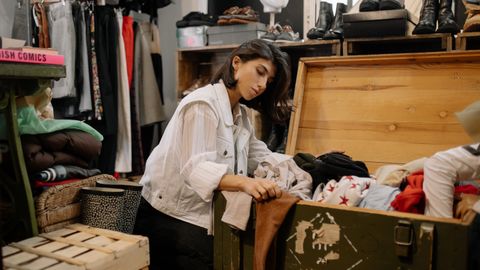
Almost everyone has bought something that looked excellent in a shop and wrong at home. The explanation is rarely mysterious, and it is mostly light.
Colour temperature
Light sources differ in colour temperature, measured in kelvin, and this changes how colours appear.
Warm light around 2700–3000K — most retail and domestic lighting — casts a yellow-orange tone. It flatters warm colours, makes skin look healthier, and makes cool colours look muddy. A cool-toned grey can read as beige under it.
Neutral light around 4000K.
Cool or daylight-balanced light around 5000–6500K, closer to actual daylight. Reveals colour accurately and is generally unflattering to skin, which is why almost no shop uses it in a changing room.
The practical consequence: a garment's colour is genuinely different under shop lighting and under daylight. Not perceived differently — different, because colour is a property of the reflected light.
Carry the garment to a window or to the shop door and look at it in daylight. Then hold it against your face. This single habit prevents most colour mistakes, and it is particularly important for anything you will wear near your face, and for matching two items — a jacket and trousers that appear to match under shop lights frequently do not outdoors.
Colour rendering
Beyond temperature, light sources vary in how completely they render the spectrum, measured as the colour rendering index. A low-CRI source can make certain colours appear dull or shifted because it does not emit much light at those wavelengths.
This is why a red can look flat under some lighting and vivid under others, and it is why comparing two similar colours under retail lighting is unreliable.
Mirrors
The more contested subject, and worth being careful about what is actually known.
A flat mirror reflects accurately. It is straightforward to make a mirror that does not — a very slight vertical curve elongates the reflection, and this is a known technique.
Whether particular retailers do this deliberately is not something that can be established from outside, and specific claims about named shops should be treated with caution. What is unambiguous is mirror angle: tilting a mirror backward at the top produces a lengthening, slimming reflection, and this is common, visible, and not hidden.
The other unambiguous factor is how far you stand back. Changing rooms are small, forcing you close to the mirror, where you see yourself in fragments rather than as a whole silhouette.
The other environmental factors
Downlighting. Lights directly overhead cast shadows under the eyes, nose and chin, and produce shadow lines on the body that can read as definition. Front lighting is flattering; overhead lighting is dramatic.
Temperature. Shops are warm, and warm shops make you disinclined to try on coats and knitwear properly. Buying winter clothing in a heated shop consistently produces coats that turn out to be too thin.
Time and pressure. Deciding in a small room with a queue outside, holding a bag, is not conducive to good judgement. This is a design feature of retail environments and not an accident.
How to buy against it
Photograph yourself. A phone camera in the changing room shows the whole silhouette at once, which a small mirror does not, and you can look at it later in different light. It also lets you see the back.
Move. Sit down. Reach forward. Walk. Raise your arms. A garment that only works standing still is a garment you will not wear.
Step back as far as the room allows, and use the mirror outside the changing room if there is one.
Wear the right underwear and shoes. Trying trousers on with trainers and then wearing them with heels changes the length assessment entirely.
Wear what you would layer it with. Particularly for coats and jackets.
Do not buy on the first visit for anything expensive. Twenty-four hours removes most impulse purchases and almost never removes a genuinely good one.
Online has the opposite problem
Product photography is colour-corrected, lit professionally, and frequently clipped or pinned at the back to improve fit — a standard practice in fashion photography.
Which means online images show a garment fitting better than it will, in a colour that may be adjusted. The useful sources are customer photographs in reviews, which are unlit, uncorrected and considerably more honest.
And in both cases, the same discipline applies: measurements over impressions, daylight over showroom, and a photograph of yourself over a mirror.
Also by Noor Haddad
- Building a capsule wardrobe by subtraction rather than purchaseCapsule Wardrobe
- Cost per wear: the only shopping arithmetic worth doingShopping Smart
- Why some colours suit you: contrast and undertone, without the seasonsColour & Pattern
- Buying clothes secondhand online without being disappointedShopping Smart